
What is lithography?

Updated: Sep 18
History, process & practice: lithographic printmaking
A guide to one of printmaking's most storied and chemically ingenious techniques, tracing the path from Alois Senefelder's limestone experiments at the turn of the 18th century to the hand-pulled editions we make today.

At the heart of lithography is a simple principle: oil and water don't mix.
No carving, no cutting into a plate and no acid eating into metal. A drawing on a flat surface, some water, some ink, and a press. The fact that this process endures and produces prints that can speak many different languages, from subtle crayon textures to bold painterly gestures and also photographic imagery, never really gets old even after many years of printing. The way the resulting image looks is based on the materials, the hand that wields the tools and the chemical qualities of the printing surface, stone or metal. The chemistry of lithography can become a little complicated and that's where skilled printers and print studios are an important part of the process and why collaboration is inherently at the core of this printmaking technique.
If you've ever been curious about what lithography actually is, where it came from, how it works, and why artists keep coming back to it after more than two centuries, you're in the right place. At Milestone Graphics, we've been printing, practicing and teaching lithography since 1976, and we love talking about it.
A brief history of lithography

Lithography was invented in 1796 by Alois Senefelder, a Bavarian playwright who was trying to find a cheaper, faster way to copy manuscripts for his plays. Senefelder's first attempts at reproducing his manuscripts included engraving copper plates using intaglio printing methods, which proved to be too labor intensive and expensive. His initial experiments involving limestone used a more relief-minded approach. Senefelder discovered that when he used a grease pencil to jot down a list onto a local piece of limestone, a type of sedimentary rock widely available in the Bavarian region, he could chemically etch away a layer of the limestone that was not covered by the greasy pencil. This created text (or image) that was a raised surface which could then be inked and printed in a relief printing fashion, similar to the way type was arranged and printed for books. This relief-minded process was one that he and many others at the time were used to and it was of course the first consideration.
To Senefelder's benefit and the benefit of the whole world of printing, this new print process didn't require the painstaking arrangement of letters, casting of type in metal, carving a block with the utmost precision or incising a piece of copper. Through further experimentation, Senefelder discovered something more remarkable: lithography was possible to be used as a chemical process unlike print methods that came before (relief printing & intaglio). Stone lithography takes advantage of the chemical properties of limestone and allows for a much faster printing process. The discovery of the lithographic process was the discovery of planographic printing, no hills and valleys, just chemical differences in the unified printing surface. Greasy drawing material is applied to the stone and after dusting the image with rosin and talc and then treating the whole surface with a mild solution of gum arabic and nitric acid, the drawn areas accept oil-based ink while the dampened bare stone pushes the ink away.
"If I had possessed the necessary money, I would have bought types, a press and paper, and printing on stone probably would not have been invented so soon."
— Alois Senefelder, A Complete Course of Lithography, 1819
Lithography was first used as a way to reproduce things cheaper, faster, and more easily than the traditional print methods that came before it. But once artists and innovators got wind of the process and what it was able to achieve, there was interest in harnessing its power for fine art printing. Senefelder attempted to attain full-rights patents for his discoveries and although he succeeded, he did sell the rights later on. After wanting to publish the work of composer Franz Gleissner, Senefelder finally shared the rights of his lithographic process with the Offenbach brothers, Johann Anton André and Philipp. They established print shops in London and Paris and many others popped up throughout Western Europe shortly after that, spreading the use of lithography and training a very new and fresh cohort of printers in the technical aspects of the process.

Philipp Offenbach is credited for the first portfolio of fine art prints ever to be printed using the lithographic process in the very early 1800s: Specimens of Polyautography. The artists included collaborated with the printers knowledgeable in the lithographic process, including the president of the Royal Academy at the time, Benjamin West. His lithograph entitled The Angel of the Ressurrection is widely studied and well-known with print scholars as a characteristic image from this early time in the history of lithography. The prints included in this portfolio were pen and ink style drawings done on stone, but the grouping was meant to showcase lithography as a fine art medium rather than the reproductive label that was associated with printmaking at the time.
This portfolio and the work between the artists and printers set a very rudimentary, early standard for the collaborative tradition in printmaking that we still see today: artists seeking out the expertise of a skilled shop/printer who has the technical knowledge, materials, equipment and a knack for working with a variety of people.


Within decades of it's invention, lithography had spread across Europe and America. Artists like Goya, Daumier, Delacroix and Toulouse-Lautrec quickly recognized what made it special: the artist could draw with a crayon or a brush, and the stone easily captures every gesture, every texture, every mark exactly as you made it. That kind of immediacy was something etching and woodcut simply couldn't offer.
Through the nineteenth and twentieth centuries, lithography became the go-to medium for illustration, advertising, and posters. Innovations in using aluminum plates allowed for offset lithography, a mechanized version of the original process which still drives the majority of commercial printing today. But hand-pulled stone lithography, practiced in studios and workshops like ours, never went away.
It's a living tradition.
The lithographic limestone: Solnhofen, Bavaria
The limestone used in traditional lithography isn't just any limestone quarried out of the ground. It comes from a specific geological formation in southern Bavaria, known as the Solnhofen Plattenkalk, and started it's process of formation in the Jurassic era roughly 150 million years ago in a network of shallow, calm lagoons. The conditions of that ancient environment produced an extremely uniform stone: dense, fine-grained, and chemically stable in a way that no other limestone deposit has quite matched. The grain is so fine, with particles in the range of 4 to 10 microns, that drawing materials respond to it with a sensitivity that produces tonal gradations no coarser stone can replicate.

In print shops worldwide, these stones are continuously in rotation, re-grained and reused across many editions. This is a thread of continuity that makes working with lithographic limestone feel different from almost any other printmaking material. We've written a dedicated post about the geology and quarrying history of Solnhofen limestone if you'd like to go deeper.
How lithography works
The chemistry behind lithography is equally simple and complex. The Bavarian limestone used, a dense, fine-grained calcium carbonate, turns out to be uniquely well-suited to the process. Aluminum plates are also widely used today and offer many of the same qualities in a much lighter package with some limitations. There is also photolithography, done on thinner aluminum plates coated in a light sensitive emulsion, which made for ease of creating imagery with photographic films, but it can also be used with hand drawn sources. Normally, the artist draws directly on the matrix, stone or plate, using a greasy material: lithographic crayons, tusche (a liquid drawing medium), or even ordinary grease. Over time, there have been many other materials and innovations in how images can be made, but limestone and grease are the original duo.
Once the drawing is complete, the stone or plate matrix goes through a chemical preparation called etching, though it's nothing like a plate being bitten by acid in intaglio printmaking. Solutions of gum arabic and different acids based on the surface material being used (stone or metal plate) are applied in order to desensitize non-image areas and help lock the image in place. These solutions need to be carefully chosen based on the drawing material used and their greasiness. What's happening chemically? The gum arabic forms bonds with the areas of bare limestone, making them soak up water and push away oily ink. The drawn areas react oppositely: they'll accept greasy ink but reject water. The image areas are hydrophobic and oleophilic while the non-image areas are hydrophilic and oleophobic. From that point on and once everything is stable, the two zones stay reliably separate every time you print.
It is all an understanding of chemistry and materials, but it feels partly like magic sometimes. Draw, etch, sponge, ink, press paper to the inked surface, and the image transfers cleanly. There's a lot more to lithography than that, but at it's core, it's chemistry. Chemistry and patience.
The core principle
Lithography works entirely on the basis that oil and water do not mix.
During printing, the matrix is first dampened with water using a sponge, then inked with a leather or rubber roller. The ink, being oil-based, sits only on the drawn greasy areas. A sheet of paper is placed on the inked printing surface, and the two are run through the press together under even, firm pressure. The result is a faithful impression of the original drawing. This process is repeated for as many prints are made in an edition.
The steps of making a lithograph
Step 1: Drawing
The artist draws directly on the prepared stone or plate surface using lithographic crayons, tusche, or other greasy materials. The matrix surface accepts gesture, texture, and mark-making unique sensitivity, allowing for a full range of tonal values.
Step 2: Etching
A solution of gum arabic and acid chemically fixes the image, making drawn areas ink-receptive and bare areas water-receptive. The image is now locked into the surface.
Step 3: Printing
The stone or plate is dampened, inked, and printed under pressure. Impression by impression, a numbered limited edition is produced, each print pulled by hand.
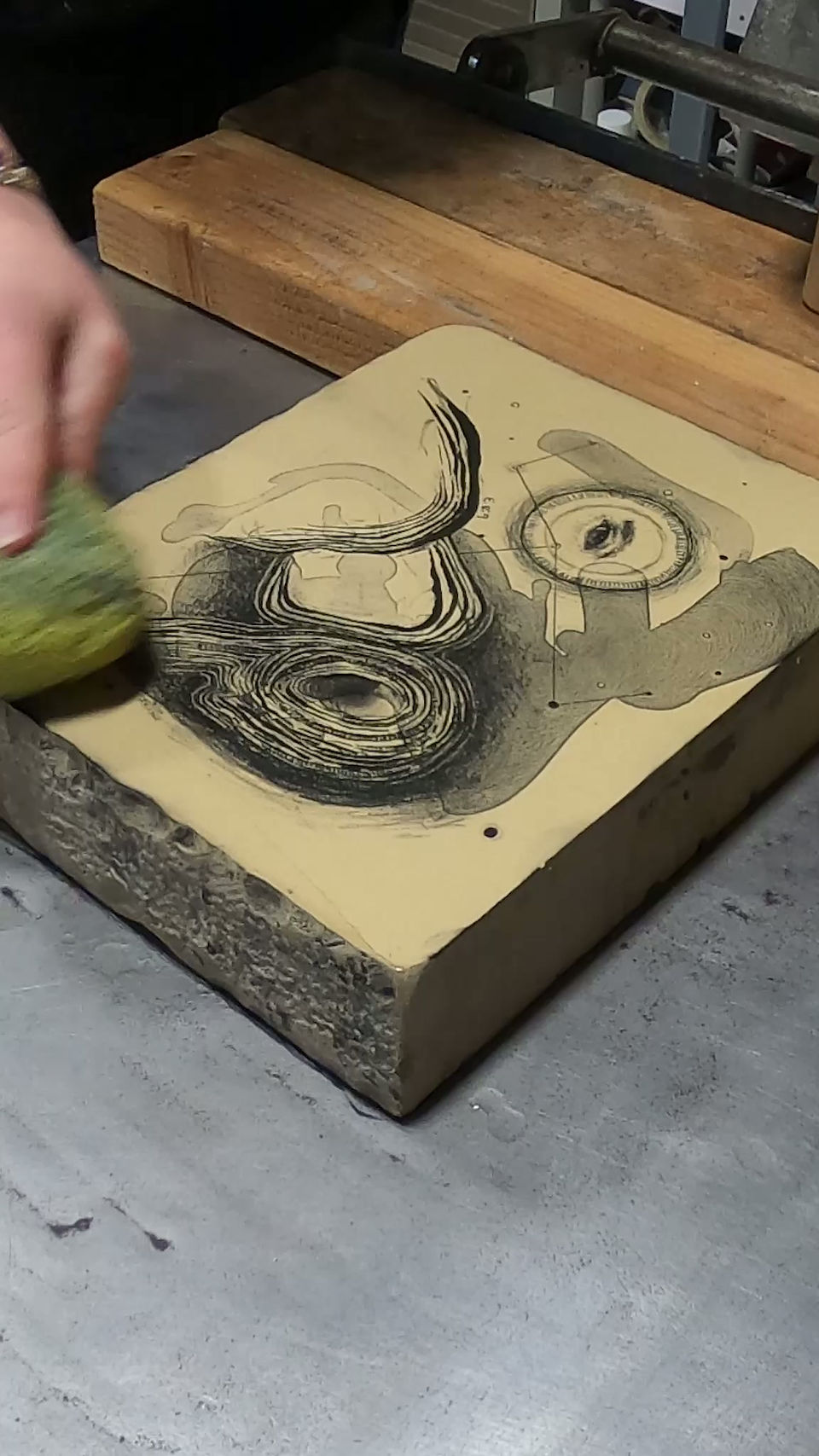
Between the major steps listed above lies a lot of nuance: the ratio of acid in the etch solutions, the consistency of the ink, how much water is on the stone or plate, the kind of paper being used to print, the pressure of the press, the humidity or dryness of your location. The list of variables can feel endless in the lithographic process and can be slightly overwhelming. This is where technical knowledge, expertise, attention to detail and a sense of curiosity about the materials in front of you are extremely important. Lithography rewards you for paying attention.
What makes lithography distinctive as an art form
Lithography is considered an autographic medium, meaning that the artist's marks and gestures are directly translated to the resulting print with faithful accuracy. This drew many creative individuals to the medium in the 1800s and still continues to do so today. With intaglio or etching, you incise the plate with tools or apply resists to prevent parts of the plate from being bitten by acid. Woodcut and linocut mean carving away everything you don't want. Lithography involves a very direct approach to how you envision and create your image: draw, and what you draw is more or less what you get. The directness is evident in the final prints in a way that's easy to see if you're comparing the original stone or plate to the print.
When working with traditional methods and materials, there is a distinct softness and richness to a lithograph. The way a crayon interacts with limestone or ball-grained aluminum produces a range of values and mark-making that are hard to achieve with other techniques. The unique pattern of a tusche wash, called reticulation, and the fluidity of working with wet materials add to the appeal of the medium. Not to mention a variety of other materials that can be used. Lithography can speak many languages and the process has evolved over time through the innovation, collaboration and experimentation of printers and artists working together.

A note on collaborative printmaking
At its core, lithography is a collaborative process. The press, the stones, plates, materials various equipment and the chemistry require genuine expertise, so most artists in this medium collaborate with a professional print studio and an experienced printer. The interaction between artist and printer, working together to transfer the idea to image and then image to paper is one of the aspects we cherish most at Milestone Graphics. It's been fundamental to our approach since the beginning.
Stone lithography vs. plate lithography vs. photolithography
Stone lithography traditionally uses Bavarian limestone that comes in slabs multiple inches thick, with larger ones often weighing hundreds of pounds. Each of these lithographic stones has its own history. They were quarried long ago, ground flat, used to print something, then resurfaced and used again. A repeating cycle. A stone that's been in the studio for decades may have held dozens of different images. There's something genuinely wonderful about how each stone has a distinct history and it's own personality.
Chemical printing: Using metal plates
The use of metal plates in the lithographic process came along in the twentieth century as a practical alternative. Aluminum and zinc plates are lighter, less expensive, easier to store Photolithographic plates can be wrapped around a drum for offset printing. Maybe you'd like to imagine yourself carrying a litho stone around to sketch like the gentlemen pictured in Horace Vernet's lithograph... or maybe you wouldn't.

In lithography using metal plates the chemistry is different than stone and therefore these processes require some different acids or chemicals to make the image stable. However, printing happens in the same fashion: sponging, inking, printing onto paper with pressure.
Ball-graining gives metal plates their tooth: the plate is roughened using steel ball bearings and abrasive materials like grit or sand. This graining process creates a texture that holds water and accepts drawing materials much like limestone does. Unlike limestone, however, plates made of aluminum or zinc are non-porous, meaning they hold water through surface chemistry and grain texture alone rather than through the microscopic absorption that limestone's calcium carbonate structure provides. The composition and qualities of metal plates require a different etch chemistry than limestone, most commonly utilizing tannic and phosphoric acids rather than nitric acid. It's a mineral surface (limestone) vs. metal surface (aluminum or zinc) comparison, so the chemistry has to change to accommodate a materials that require less aggressive approaches to desensitization, or treating non-image areas to make them hydrophilic (water-absorbing) and oleophobic (oil-repellent).
Photolithography: when light becomes the drawing tool
Photolithography takes the same underlying principles and brings light sensitive materials into the mix. Light sensitive plates are now typically available for purchase pre-coated in an emulsion and are used in both fine art and commercial offset lithography. There are both positive and negative working plates, although most often you'll find positive plates in fine art lithography now: what you expose to light will wash away, while the areas that are dark to the light will stay and later print. Ultra-violet light sources are used to expose these plates and require dark environments like a dark-room, special lights called safe-lights that do not affect the light sensitive materials, and exposure units that are used to expose the plates. Once the plate is exposed it is developed in a specific solution, rinsed, dried and treated with a layer of gum arabic (a familiar friend from stone & plate). After this, the photolitho plate is ready to print.
A photolithographic plate still prints on exactly the same oil-and-water principle as any other lithograph, just with the matrix or image being established by light from a transparency, rather than the artist taking crayon or brush in hand and applying it directly to stone or ball-grained metal plate.
The innovation of this photo-based process ("photo" meaning light here, not picture), one who's roots began as early as the 1850s, opened up the medium in an expansive way. First came the ability to just transfer marks with light and then photographic imagery, collage, precise halftone reproduction came with later experimentation, things that are simply beyond what a crayon can do on stone. Artists have been combining photo-based and hand-drawn elements in lithographic editions since the mid-twentieth century, layering the intimacy of direct mark-making with the precision of photographic films and halftone. Photolithography also, in a very different and highly refined form, underlies how semiconductor circuits are made, which is a great reminder of how far Alois Senefelder's original idea has traveled.
Hand-drawn vs. photo-based: a question of intent
Photolithography isn't a shortcut in the lithographic process; it's a different tool. Every decision that shapes a photolithograph (the source image, whether hand-drawn or printed as a digital transparency, the exposure, the chemistry, the paper, the ink) takes just as much craft and intentionality as traditional stone work. Many artists use both approaches in a single edition, mixing the depth of a hand-drawn stone layers with the precision of photolitho layers. The appropriate matrix or combination of matrices is chosen for each project based on the artist's vision: stone, aluminum plate, and photo-based processes.
Lithographic limestone and its enduring allure
With all of that being said, stone lithography has something special going on in the limestone's grain and surface chemistry. The surface can be pushed and pulled, with drawing material able to be added and then scraped away mechanically. Many artists really lean towards this ability to add and subtract back and forth in order to pull out their image. If you've ever had the chance to work on limestone, you'll know it's an incomparable surface.
The limited edition: what it means

A fine art lithograph is a limited edition original print, not a reproduction of an existing image. Each impression is pulled by hand from the original matrix, one at a time. The edition is numbered (3/25 means it's the third print from an edition of twenty-five), and once the run is complete, the stone or plate is traditionally cancelled or destroyed so no additional prints can ever be made.
That's what sets a fine art print apart from something run off a digital printer like inkjet prints or giclées. Every choice that shapes the impressions, the choices in drawing materials, the ink color, the paper, the size, the amount of prints pulled in the edition, involved the artist's judgment. A fine art lithograph is an original work. There just happen to be more than one of them.

Since 1976, Milestone Graphics has been a place where artists of all levels can explore lithography and other traditional print media in a welcoming, collaborative setting. We're the oldest professional print shop still operating in Connecticut, and keeping this craft alive and accessible matters a lot to us. Hand-pulled printmaking is slow, physical, and truly analog. It's a bit old-fashioned in how it works, and we think that's exactly what makes it worth doing.
Work with Milestone Graphics in New Haven, CT
Lithography is sometimes hard to appreciate until you've watched it happen in person. The presence of the stone, the way tusche dries on its surface, and the moment the paper lifts away and you finally have your first impression. This experience is one you don't know the magic of until you see it in person. If you're an artist who's been curious about lithography, or a collector who wants to understand the process behind the work, come by the studio. We'd love to show you around.
Sources
Britannica: Alois Senefelder. britannica.com/biography/Alois-Senefelder
Paul Croft: The Discovery of Lithography (on Senefelder's attempt at patents and selling his knowledge to the Offenbach brothers, Friedrich and Philipp André) https://www.paulcroft.org/spgw-grease.html
The Metropolitan Museum of Art / Specimens of Polyautography, Consisting of Impressions taken from Original Drawings, Made on Stone purposely for this Work. https://www.metmuseum.org/art/collection/search/355586
The Metropolitan Museum of Art / Essays/ The Print in the Nineteenth Century: Lithography (on Goya, Daumier, Toulouse-Lautrec). https://www.metmuseum.org/essays/the-print-in-the-nineteenth-century
Encyclopaedia Britannica: Solnhofen Limestone. britannica.com/science/Solnhofen-Limestone
UC Berkeley Museum of Paleontology: The Solnhofen Limestone of Germany. ucmp.berkeley.edu/mesozoic/jurassic/solnhofen.html
Clinton Aluminum: Aluminum Uses in Lithographic Plates. clintonaluminum.com/aluminum-uses-in-lithographic-plates
History of Science Museum, Oxford: Lithography. hsm.ox.ac.uk/lithography
World of Printmaking: Lithography: What it is, how it works, & its history. worldofprintmaking.com/process/lithography
Paul Croft: The Discovery of Lithography (on zinc and aluminium plates). paulcroft.org/spgw-grease.html
Computer History Museum: 1955: Photolithography Techniques Are Used to Make Silicon Devices. computerhistory.org/siliconengine
Comments